

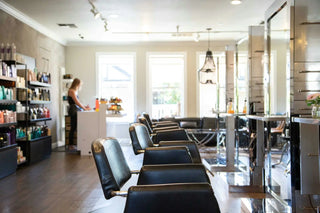
If your salon furniture forces you to adapt to it, you'll likely end up paying for it in time, posture, and maintenance. Therefore, below you'll find a guide on how to choose hairdressing furniture for intensive use that is durable, ergonomic, and easy to maintain. Let's get started!
Why is it key to invest in quality professional furniture?
A professional furniture for beauty salons Robustness reduces incidents, improves safety, and maintains workflow without slowing down the team. For this reason, investing in quality is a smart decision that protects your operations and your image with the client.
Materials and finishes: a quick guide for demanding environments
Structure and strength of materials
The structure is the backbone of the furniture, and if it gives way, everything else loses value, even if the design is impeccable. Therefore, in hairdressing furniture, it's best to prioritize sturdy frames, well-executed joints, and mechanical components that won't become misaligned with vibrations and constant movement.
Steel, aluminum, engineered wood: advantages and disadvantages
Now let's break down the advantages and disadvantages of the most common materials for hair salon furniture. Let's start with steel, which is usually known for its rigidity and stability. Even so, it needs proper treatments to prevent corrosion in humid environments.
Aluminum, on the other hand, weighs less and is highly resistant to oxidation. However, it can become marked or deformed more quickly if it is not properly sized for continuous load and use.
Engineered wood and boards designed for professional environments can be very stable. However, in shampoo basins and wet areas, the key lies in the edging, the sealing, and the quality of the coating to prevent warping or cracking over time.
Comparisons of resistance to heavy use
In use, the most damaging factors are repetition, humidity, and the daily movement of staff and customers. Therefore, all other things being equal, products that combine a solid metal structure with durable coatings and professional hardware tend to last longer, as they better withstand fatigue and frequent adjustments.
At the same time, a well-protected technical board works excellently in workstations if the surface and edges are designed for frequent cleaning and hot tools.
Finishes that matter in a professional salon

Chemical-resistant surfaces
Among dyes, oxidizers, sprays, alcohols, and disinfectants, it's best to choose coatings that can withstand accidental contact and repeated cleaning without fading or peeling. Furthermore, the more continuous the surface and the better the edges are sealed, the less likely liquids are to penetrate and cause swelling or permanent stains.
High-performance upholstery
As for upholstery, it suffers from friction, dyes, water, and temperature changes. Therefore, it's best to prioritize materials that don't crack and are quick to clean without absorbing moisture, such as high-quality faux leather.
Functionality and ergonomics for styling professionals
Chairs and armchairs: adjustment, support, comfort for continuous workdays
During a long day, stability and support are invaluable after many repetitions of cutting, coloring, and styling. That's why a good professional chair should offer smooth adjustment, a stable base, and support that doesn't sag. This way, the client will remain comfortable, and the stylist will work at an appropriate height.
Modular workstations: flow, accessible storage
Likewise, the workstation should minimize unnecessary steps, as every second counts when the salon is full. In this regard, the modularity of the furniture should be considered to help adapt it to your team and your services. This also allows for rearranging without compromising sturdiness.
Integrated accessories that make daily work easier
And when accessories are intelligently integrated, you avoid improvising with solutions that end up damaging surfaces and corners. The result is more organization, fewer loose cables, fewer tools leaning where they shouldn't be, and therefore, fewer marks and breakages. Additionally, this organization translates into a more professional experience for the customer.
How to measure your living room before choosing furniture
Functional areas: washing, cutting, styling, waiting
Start by drawing your floor plan to scale, even if it's a simple one. Then, measure the length and width of each usable area in centimeters, subtracting the pillars, radiators, columns, and door frames.
In the shampoo area, for example, leave a comfortable, clear aisle behind or to the side of the shampoo bowl so the stylist can move around easily and the client can sit down and stand up without bumping into anything. In the hair cutting and styling area, measure the space the chair will occupy when it swivels and reclines. Likewise, make sure there is enough space around the client to move around without bumping into carts or walls.
And in the waiting area, measure the available space for benches or chairs in the waiting room without obstructing the path to reception. Here, leave a clear passage so the customer doesn't have to cross the work area.
Staff and customer flow to optimize performance
The essential measurement here is the width of the circulation area. Therefore, measure the aisles and see what happens if two customers, a staff member, and a shopping cart are all in the same space at the same time. From there, determine the maximum depth of your furniture, since often the problem isn't the length but rather excessive depth.
It also measures the openings of furniture that face into a hallway to avoid obstructing traffic. Finally, it measures the distances between workstations as if they were "streets" in the salon, leaving enough separation to work with hot tools without touching the client next door.
Maintenance and life cycle of professional furniture
In conclusion, the durability of professional salon furniture depends not only on its manufacturing process but also on its care. Therefore, it's essential to maintain surfaces with appropriate products, dry damp areas, and regularly check mechanisms to prevent minor wear and tear from escalating into major breakdowns.
Frequent questions
What furniture is essential for a professional hair salon?
The essentials are what sustain the core service and daily workflow. This includes reliable workstations, operational stations, and the necessary washing facilities if you offer that service.
What to consider before buying professional furniture?
Before buying, it's wise to assess your workload, the types of services you perform most often, and the conditions of the space, such as humidity, ventilation, and frequent cleaning. Based on that, you can choose based on structure, finishes, and ergonomics, and only then consider aesthetics.
Which materials withstand heavy use best?
Well-treated metal structures and quality technical boards with resistant coatings tend to perform better.
How does ergonomics affect my team's performance?
Ergonomics impacts speed, accuracy, and fatigue, and consequently also affects the consistency of the service.
Should I prioritize design or functionality?
Design matters because it communicates your brand, but in intensive use, functionality is a priority for the salon to be profitable and sustainable.
Does Grupobelleza.com offer personalized advice for B2B projects?
Yes, in GRUPO BELLEZA We support investment projects in hairdressing furniture for B2B clients, ensuring it fits the workload, salon layout, and type of service you offer. So, if you want to play it safe, Get in touch with us today.