

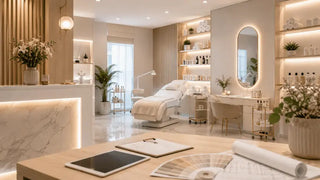
There are two types of people who open a beauty salon: those who have planned it for months and those who take the plunge with enthusiasm. The latter don't always do worse, but they do make more avoidable mistakes. This guide is designed so you don't have to learn the hard way.
The first thing you should decide before looking for a place
Looking for a location before you have a clear business model is one of the most expensive mistakes you can make. The space dictates everything else, and if you don't know what you need, you can't know if what you're looking at will work for you.
Define your specialization: general aesthetics, facial, body or mixed.
General beauty services are the most common option to start with: waxing, manicures, pedicures, basic facials. A wide range of services, a broad clientele, and a manageable initial investment. It's not the most glamorous, but it's the one that starts generating income the fastest.
Specializing in facial or body treatments offers more profit margins and a better market position, but it requires more training, more advanced equipment, and more patience to build a clientele. It's neither better nor worse; it's simply a different approach.
Who is your center aimed at and what average ticket size do you want to handle?
The average ticket price isn't a minor detail. It's the figure that tells you how many services you need to perform each month to cover expenses. If you don't have this figure clear from the start, your budget is worthless.
A high-end center needs an investment in finishes, furnishings, and ambiance that justifies its price. One focused on high turnover and affordable prices needs operational efficiency. Trying to do both at the same time usually ends badly.

How many jobs do you really need?
If you're starting out alone or with one other person, two booths are enough. Three if the venue allows it and the projected demand justifies it. More than that when starting out is over-sizing.
Each additional workstation means extra square footage, extra furniture, and higher fixed costs from day one. Growing is easy when there's demand. Reducing is much harder.
The premises: what to look for and what to check before signing
Once the contract is signed, any problems with the premises become your problems. Before you get to that point, there are things you need to verify in person; don't just rely on what the landlord tells you.
Minimum surface area depending on the services you will offer
Each autonomous community sets its own minimum requirements for the space of a beauty salon. In practice, a working treatment room needs at least 6-8 m² of usable space to work comfortably around the treatment table. Anything less and you start losing space, not gaining it.
For a small salon with two or three treatment rooms, a manicure area, and a reception area, allow a minimum of 40-50 m². Anything less is too cramped. More gives you room to grow without having to move.
Ventilation, lighting and accessibility requirements
Ventilation: essential and non-negotiable. No waxes, lacquers, or acetone. You need proper air circulation, not just a window overlooking an interior courtyard. Check for ductwork or direct ventilation to the outside before signing.
Natural light: it's not mandatory, but it makes a huge difference. In rooms without windows to the outside, artificial lighting has to work twice as hard, and even then the result is different.
Accessibility: Regulations require that premises open to the public be accessible to people with reduced mobility. Steps at the entrance, narrow doorways, or inaccessible restrooms can pose a real problem when obtaining a license.
Area distribution: booths, reception, storage and restrooms
Private booths, a reception area with enough space to work and for customers to wait comfortably, a storage area (even a small one), and decent restrooms. That's the bare minimum.
The storage area is the most underestimated. Without a place to keep stock, consumables, and equipment that isn't in use, clutter ends up invading the treatment rooms. And clutter in a beauty salon has a direct impact on its image.
Licenses and procedures for opening a beauty salon in Spain
There are no shortcuts here. Opening without the proper paperwork is a gamble that could end in fines, temporary closure, or worse. The procedures are what they are, and the only thing you can do is manage them well in advance.
Business license and responsible declaration
In most municipalities, beauty salons can open by submitting a declaration of responsibility, which significantly speeds up the process compared to a traditional business license. It depends on the local council and whether any construction work is underway.
If the premises need renovation to suit your business, add a building permit to the process. This can add weeks or months to the opening timeline. Make sure you mention this from the start.
Health authorization: when it is mandatory and how to obtain it
It depends on the treatments you will be offering and the autonomous community. In general, if you manipulate tissues, use equipment of a certain intensity, or apply substances that affect the body, you need health authorization from the relevant regional health authority.
Consult with the relevant authority before closing the business. Not after. If the space doesn't meet the technical requirements, it's better to know before signing than when it's too late to back out.
Registration as self-employed or incorporation of a company
If you work alone, registering as self-employed is the natural path. If you anticipate high revenue from the outset or plan to partner with others, a limited liability company (SL) might make sense. However, this is a tax decision, not an administrative one, and warrants a discussion with an advisor before deciding.
Furniture: what a beauty salon needs to function

Furniture is what the customer sees and what you use every day. Buying cheap here is one of the mistakes that costs you most in the long run. You don't have to go to the other extreme, but there's a minimum quality standard below which you shouldn't fall.
Beauty treatment tables: types and selection criteria according to treatments
Fixed, manually height-adjustable, or electric. To begin with, one adjustable manual stretcher It covers most services well. Electric ones are more convenient, for both the customer and you, but the price goes up considerably.
What you can't overlook: that the upholstery is easy to clean and disinfect, that the frame can withstand daily use without creaking or loosening, and that the backrest is adjustable if you're going to be doing facial treatments. Everything else is secondary.
Makeup and beauty chairs: comfort for the client and ergonomics for the professional
For services where the client is seated—makeup, eyebrows, eyelashes, express facials—you need a chair with an adjustable backrest and height. Reclining is useful if you want to work with the client lying down without using a treatment table.
The upholstery needs to withstand repeated cleaning products and disinfection. Attractive finishes that deteriorate in six months are not a good buy.
Manicure table and podiatry chairs
The manicure table You need an acetone-resistant surface, enough workspace, and good lighting, either integrated or with the option to attach a lamp. If you're going to use an electric drill, consider tables with a built-in dust extractor. Nail dust in the air is a real problem.
A podiatry chair is a larger investment, but if you're going to offer therapeutic pedicures, there's no alternative. Choose one with durability in mind: it's a piece of furniture that will see a lot of use and needs to withstand it.
Magnifying lamps, trolleys and auxiliary furniture
A magnifying lamp is essential in any facial treatment room. Choose a cool-spectrum LED if possible, as it reproduces true skin tones more accurately. A flexible neck and a stable base are all you need to consider.
Auxiliary carts seem like a minor detail until you work without them. Having to get up to look for something every few minutes in the middle of a treatment is a workflow problem that's solved with a good, well-organized cart.
Reception and waiting area: first impressions also count
The reception desk needs to be functional: space for a computer or tablet, the POS terminal, and the products you sell, without looking like a storage room. The waiting area doesn't need to be large. It needs to be comfortable and not feel like an afterthought.
It's the first thing the customer sees upon entering. It's worth treating it as such.
Equipment: what equipment to incorporate and in what order
Equipment is where you can waste the most money when opening a business. High-cost equipment that doesn't pay for itself because there isn't enough demand to justify it. The rule is simple: start with what you know you'll use from the very first month.
Basic equipment to get started without overinvestment
High-frequency devices for facial treatments, basic ultrasound, and manicure and pedicure tools. With these, you can offer a more than reasonable service menu without having tied up cash in equipment you're not yet sure will be profitable.
Steamers, wax melters and manicure and pedicure devices
He facial steamer It's one of the first devices worth having: it prepares the skin, facilitates extractions, and the client perceives it as part of a meticulous protocol. Models with ozone add a disinfectant function, useful for problem skin.
For wax melters, a single-pot model is sufficient to start with. Multi-pot models are better suited for salons with high-volume waxing services. Prioritize features such as consistent temperature control and ease of cleaning.
Electric drill bits, UV/LED lamps for gel and shellac, nail dryers. These are moderately priced and commonly used items. The important thing here is that they are reliable and that replacement parts are readily available.
When does it make sense to upgrade with advanced equipment?
When you have an established customer base, when demand exists, and when you've been able to calculate amortization with real data, not optimistic projections, that's the time to look. aesthetic equipment Higher level treatments: radiofrequency, pressotherapy, cavitation, pulsed light.
Before buying any equipment over €5,000, calculate how many monthly sessions you'll need to recoup the cost in 18-24 months. If that number is beyond the reach of your current client base, wait.
How much does it cost to set up a beauty salon: indicative items and ranges
The exact figures depend on the city, the venue, and the decisions you make in each game. What you can do is get a clear idea of the magnitude of each one before you start.
Works and adaptation of the premises
If the premises are in good condition and only need minor adaptations, expect to pay between €5,000 and €15,000. If a complete renovation is required, budget at least €30,000 and add a 15-20% contingency fee for unforeseen expenses. There are always unexpected costs involved in construction.
Get at least three quotes. And negotiate that part of the payment is contingent upon satisfactory delivery.
Furniture and equipment
For two or three treatment rooms with mid-to-high-quality furnishings, expect to spend between €8,000 and €20,000 on furniture alone. Basic equipment adds another €3,000-€8,000 on top of that. These are wide ranges because they depend heavily on the brands and models you choose.
Initial stock of products and consumables
Salon cosmetics, single-use consumables, and retail products. Between €2,000 and €5,000 is a reasonable starting point. More if you plan to work with several treatment lines from day one.
Opening costs, insurance and first months of operation
Security deposit and first month's rent, municipal taxes, notary fees if you incorporate, signage, website, management tools. Public liability insurance is mandatory and non-negotiable.
Besides all that: set aside at least three months' worth of fixed expenses in your account before opening. Not as a goal, but as a requirement. Opening without that cushion means starting with your back against the wall.
Common mistakes when opening a beauty salon and how to avoid them
Find a location before having a clear business model. It has already been said, but it deserves to be repeated because it is the first and the most expensive.
Not verifying the health requirements before signing. Finding out that the premises cannot obtain health authorization after signing the contract is a very complicated situation to resolve.
Purchase advanced equipment before having clients. Equipment worth €15,000 that is not being amortized is a financial burden at the most delicate moment of the business.
Open without a cash cushion. The first few months of any business are the hardest. Customers take time to arrive. Fixed expenses don't wait.
Choosing furniture based solely on price. Cheap furniture deteriorates faster, looks worse, and needs replacing sooner than expected. The price difference between a mediocre piece and a good one doesn't justify the savings.
Neglecting the reception and waiting area. These are the first few meters the customer sees. If those meters aren't up to the standard of the rest, the perception of the center suffers, even if the booths are perfect.
Not planning communication from the beginning. Name, image, social media, Google Business. The later you start, the later you become visible to potential customers in your area.
Checklist: Everything you need before opening the doors
Before opening, review each point:
Planning
✔ Defined business model: specialization, target audience and average ticket
✔ Number of cabins and positions decided
✔ Total estimated budget with contingency margin
Local
✔ Sufficient surface area for the planned services
✔ Actual ventilation verified on site
✔ Accessibility in accordance with regulations
✔ Distributed areas: cabins, reception, storage, restrooms
Formalities
✔ Responsible declaration or activity license submitted
✔ Health authorization obtained (if applicable in your community and services)
✔ Registration as self-employed or incorporation of a company
✔ Tax registration
✔ Public liability insurance contracted
Equipment
✔ Stretchers installed and verified
✔ Beauty or makeup booth chairs
✔ Manicure table and podiatry chair if applicable
✔ Magnifying lamps and trolleys in each booth
✔ Equipped reception and waiting area
✔ Basic equipment installed and tested
Operation
✔ Full initial stock
✔ Appointment management software configured
✔ Fixed price and service charter
✔ Active Google Business and social media presence
✔ Three months of fixed expenses in account
With all this in order, you can open with a clear head. You'll work out the rest as you go, which is also part of the process.