

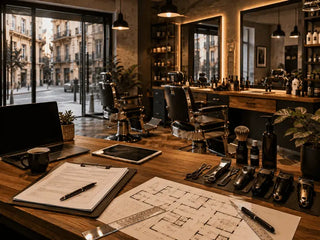
Opening a barbershop in Spain isn't as simple as finding a location and putting up a sign. There are procedures, health regulations, qualifications to prove, and minimum equipment requirements to meet before welcoming your first client. This guide covers everything you need to have in order to open smoothly.
What is the legal difference between a barbershop and a hair salon?
For administrative purposes, a barbershop and a hair salon are distinct businesses, although they share many elements. A barbershop falls under the category of hairdressing services and hair treatments specifically for men, with a particular focus on straight razor shaves and beard grooming. However, regulations vary by autonomous community, and in many cases both activities are regulated under the same heading.
What's relevant in practice: the required qualifications, premises requirements, and hygiene protocols can differ depending on your location. Before taking any steps, consult the specific regulations for your region. What applies in Madrid isn't exactly the same as in Catalonia or Andalusia.
Premises requirements before starting the procedures
The premises must be in suitable condition before any paperwork is submitted. If the space doesn't meet the technical requirements, the rest of the process won't move forward. And discovering this after signing the lease is a problem best avoided.
Minimum surface area, height and layout
General regulations require a minimum work area of between 15 and 20 square meters, although the exact minimum depends on the autonomous community. The minimum ceiling height is usually set at 2.5 meters. That said, with these minimums you're cutting it very close: a functional space for two chairs with room to maneuver comfortably needs more.
A space of 30-40 m² is a reasonable starting point for a small barbershop with one or two stations. Below that size, the space begins to affect both the customer experience and the barber's workflow.
Ventilation, lighting and accessibility are mandatory
Ventilation must ensure continuous air renewal. A small window that is opened occasionally is insufficient. If the premises do not have direct access to the outside, you will need to install a mechanical ventilation system. This is a health requirement that is checked during the inspection.
The minimum lighting requirement for the work area is typically 500 lux. In practice, any barbershop that wants to operate efficiently needs more: straight razor shaving and beard shaping require precise lighting. Natural light is beneficial, but it doesn't replace a well-designed artificial lighting system.
Regarding accessibility, the premises must be accessible to people with reduced mobility. Steps at the entrance, narrow hallways, or inaccessible restrooms may prevent you from obtaining the license. Verify this before signing.
Areas that the premises must have according to the regulations
The regulations distinguish between the work area, the waiting area, and the restrooms. The work area must be functionally separate from the waiting area. Restrooms are mandatory and must include sinks with hot and cold water, soap, and a hygienic drying system.
In addition, the premises must have a designated area for sterilization and storage of materials. This doesn't need to be a separate room in smaller premises, but it must be a clearly defined area equipped for this purpose.
Licenses and permits to open a barbershop

The administrative procedures aren't the most exciting part of the process, but they're what determine whether you can open or not. And handling them poorly or after the deadline has direct consequences on your opening date.
Business license or responsible declaration
In most municipalities, barbershops can opt for the self-declaration opening procedure, which speeds up the process compared to the traditional business license. You submit the documentation, declare that you meet the requirements, and, in principle, you can open without waiting for an official decision.
If the premises require renovations, the process becomes more complicated: you'll need a building permit, and the opening date could be extended by several months. Keep this in mind when planning your timeline.
Technical project: when it is necessary and what it should include
It is not always mandatory, but in premises of a certain size or with installations that exceed certain thresholds of electrical power or mechanical ventilation, the city council may require a technical project signed by an architect or engineer.
When necessary, the project should include the layout of the premises, the installations, the materials, and compliance with applicable regulations. Hiring a technician with experience in healthcare or personal service premises saves you time and avoids errors at this stage.
Registration as self-employed or incorporation of a company
If you're going to be self-employed, registering with the RETA (Special Regime for Self-Employed Workers) and the Tax Agency are the two essential steps before you can start invoicing. If you're going to open a business with partners or anticipate high revenue from the first year, a limited liability company (SL) might be more tax-efficient. It's a decision worth discussing with an advisor before making.
Mandatory insurance and other procedures prior to opening
Public liability insurance is mandatory to operate your business. It covers damages you may cause to customers while providing your services: a burn, a reaction to a product, a fall on the premises. Without it, you cannot open, and working without it is an unnecessary risk.
In addition to this, you'll need to pay for business insurance, register with the IAE (Economic Activities Tax) if applicable, and, if you're hiring staff, register them with Social Security before they start working. Not after.
Required qualifications and professional certificates
This is one of the points where the most doubts arise, especially among barbers who have been working for years without formal training. The regulations are clear, although their application varies.
What accreditations does current legislation require?
To work as a barber in Spain, a Professional Certificate in Hairdressing or a Technician's Certificate in Hairdressing and Hair Cosmetics is generally required. Some autonomous communities also recognize specific barbering qualifications. In all cases, at least one person in the establishment must hold the corresponding qualification.
The business owner doesn't have to be the one cutting hair, but someone with the proper qualifications must be associated with the establishment. This requirement is verified during the health inspection.
How to regularize the situation if the staff does not have qualifications
If you have been working for some time without formal qualifications, the most common way is to accredit your professional experience through the procedure for recognizing professional skills acquired through work experience, which is regulated at the state level. This requires documentation, an evaluation, and, in some cases, a practical test.
It's not a quick process, so if this is your situation, start managing it well in advance. Waiting for the inspection to point it out is the worst strategy.
The minimum equipment required by the regulations
The regulations don't just govern the space: they also stipulate what equipment the premises must have to operate. There's a mandatory minimum, and then there's what you need to work properly. These don't always coincide.
Mandatory furniture in the work area
Each job position must have a barber chair Adjustable in height and tilt, a front mirror, and adequate lighting. A shampoo basin or wash tub is mandatory if hair washing services are offered. The work surface must be made of a smooth, waterproof material that is easy to disinfect.
He barber's vanity It's the central element that integrates the mirror, tool storage, and workspace. Choosing the right one directly impacts the barber's ergonomics and the overall image of the station.
Hygiene requirements: sterilization, single-use products and materials
All tools that come into contact with the client's skin must be sterilized before use. This includes scissors, razors, combs, and any reusable instruments. Regulations require the use of an autoclave or other approved sterilization system, or the use of single-use materials when sterilization cannot be guaranteed.
Towels and work linens must be single-use or washed at a minimum temperature of 60°C between clients. Cosmetic products must be properly labeled and stored. A record of sterilization processes must be available for inspection.
What the waiting area and reception need
The waiting area does not have particularly demanding technical requirements, but regulations do stipulate that it must be separate from the work area and have sufficient seating. The reception area, if it exists as a separate space, must allow for managing appointments and payments without interfering with the work area.
Beyond what regulations require, the waiting area is part of the experience. A barbershop where the customer waits standing up or in an uncomfortable chair next to the work chairs doesn't give the same impression as one with a well-designed waiting area. barber shop furniture A well-chosen space creates cohesion and communicates the level of the business from the moment the customer walks through the door.
How much does it cost to open a barbershop: main expenses

The figures vary considerably depending on the city, the condition of the premises, and the equipment choices. But knowing the approximate cost of each item before starting is what separates a realistic budget from an estimate that later falls short.
Premises adaptation and works
If the premises are in good condition and only need minor adaptations—painting, a partition wall, some minor electrical work—you can expect to pay between €5,000 and €15,000. If it requires a more extensive renovation, the range increases to €20,000-€40,000 or more, depending on the size and the level of finish you require.
In construction, unexpected events always occur. Set aside 15-20% of the budget as a safety margin and get at least three quotes before choosing a contractor.
Professional furniture and equipment
For a two-station barbershop with medium-to-high-quality equipment, the furniture—chairs, styling stations, waiting area, reception—can range from €6,000 to €15,000. barber accessories —tool holders, dispensers, auxiliary mirrors, workstation lighting— add between €500 and €2,000 extra depending on what you choose.
This is not the area where you should cut corners. Barber shop furniture is used for many hours a day for years. Cheap items end up being expensive when they deteriorate prematurely or can't withstand intensive professional use.
Opening costs, licenses and first months
Security deposit and first month's rent, municipal taxes, notary fees if you incorporate, liability insurance, exterior signage and labeling, website and management tools. In total, this expense usually ranges between €3,000 and €8,000 depending on the municipality and the decisions you make.
Add to all that a minimum three-month cushion of fixed expenses before opening. A new barbershop takes time to build a solid clientele. Opening with just enough cash on hand puts you in an unnecessarily precarious position from day one.
Final checklist: requirements to open a barbershop in Spain
Before opening, double-check that you have covered every point:
Local
✔ Minimum surface area in accordance with regional regulations
✔ Free height of at least 2.5 meters
✔ Sufficient ventilation verified on site
✔ Minimum illumination of 500 lux in the work area
✔ Accessibility for people with reduced mobility
✔ Separate zones: work, waiting, restrooms and sterilization area
Procedures and licenses
✔ Responsible declaration or activity license submitted
✔ Building permit if there has been a renovation
✔ Registration as self-employed or incorporation of a company
✔ Tax registration
✔ Public liability insurance contracted
✔ Registration of workers with Social Security (if applicable)
Degree
✔ At least one professional with a professional certificate or equivalent qualification
✔ Supporting documentation available for inspection
Equipment and hygiene
✔ Adjustable chairs for each workstation
✔ Mirror and light point at each station
✔ Hair washing basin or washing sink if washing services are provided
✔ Approved sterilization system or single-use material
✔ Single-use towels and linens or 60°C washing protocol
✔ Sterilization record available
✔ Waiting area separate from the work area
Operation
✔ Appointment management software configured
✔ Fixed price and service charter
✔ Active Google Business and social media presence
✔ Three months of fixed expenses in account
With that covered, you can open up with a clear head. You'll figure out what comes next.